
RMG – Fr Biju Michael: the journey of the South Asia Region following GC29
28 July 2026
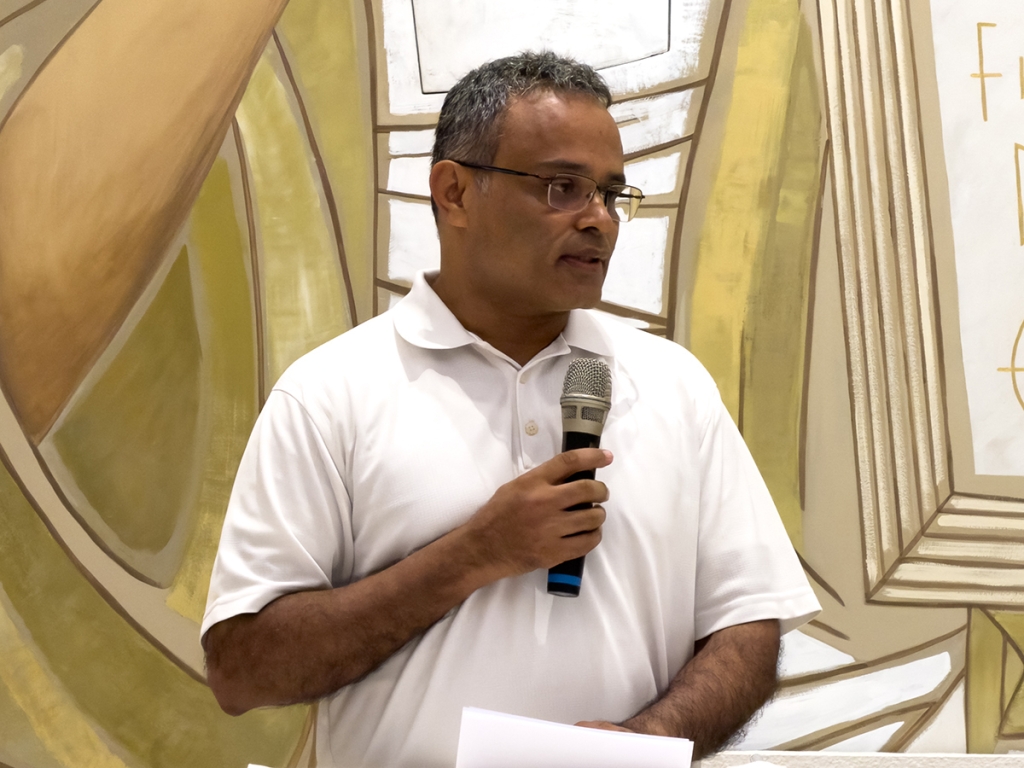
(ANS – Rome) – On the evening of Monday 27 July, Fr Biju Michael, Regional Councillor for South Asia, shared his ‘goodnight’ with the Sacred Heart Community at General Headquarters, dedicating it to young people in Asia and to his Region’s response following GC29.
A continent of young people
Fr Biju noted that, according to UNICEF (2024), Asia – comprising South Asia and parts of East Asia-Oceania – is home to more than 660 million adolescents aged between 10 and 19, accounting for around 51 per cent of the world’s adolescent population. According to estimates by the United Nations Department of Economic and Social Affairs, the continent also has around 700 million young people aged between 15 and 24, accounting for almost 60 per cent of the world’s youth. “These are not simply numbers. They are the faces, dreams, struggles and hopes of millions of young people whom the Lord entrusts to our Salesian mission,” emphasised the Regional Councillor.
The two Asian Regions also represent a significant presence within the Salesian Congregation: 4,489 Salesians out of a total of 13,558 members – around a third of the total – with the East Asia-Oceania Region numbering around 1,415 confreres and the South Asia Region around 3,074.
The Preventive System in non-Christian contexts
Fr Biju posed a fundamental question: how can we live out and promote the Preventive System in diverse religious and cultural contexts, given that the majority of young people in Asia are not Christian? A key area for reflection is youth digital culture, which international research on the Preventive System is examining with particular attention, as the digital world can prove to be not only a place of risk, but also a space for participation, organisation and responsibility.
The Regional Councillor cited the youth movements that have emerged in recent years in Sri Lanka, Bangladesh and Nepal, and the youth mobilisation currently taking place in India this month, July 2026, which arose from tensions linked to irregularities in examinations and soon expanded to include concerns about education, employment, equity and social justice. In this context, he also referred to the National Eligibility-cum-Entrance Test (NEET), the Indian national entrance exam for medical school, in which over 2.2 million candidates compete for around 150,000 available places; it is one of the most competitive university entrance exams in the world, a factor that drives many Indian students to study medicine abroad, in countries such as Ukraine, Poland, the Philippines, the United States, the United Kingdom and Australia.
“A turning point in history”, not merely an era of change
Fr Biju referred to the expression “we are not living in an era of change, but a true change of era”, which originated in the Latin American debate of the 1990s through the journal Envío (1995) and the thinking of Pablo Richard, taken up in 2007 by Rafael Correa in his inaugural address as President of Ecuador, and subsequently adopted by the Aparecida Document and Pope Francis. “Even a phrase needs time to take root in the collective consciousness. True cultural, social and ecclesial changes require even more time,” he observed, inviting the Salesians to work not only for young people, but with young people, following Don Bosco’s example.
Six priorities for the six-year term
Moving on to the concrete response of the South Asia Region following GC29, Fr Biju presented six priorities arising from the “grace of unity” and interpreting the Chapter through the dimensions of Consecration, Communion and Mission:
- Renewing the centrality of Jesus Christ, overcoming all spiritual superficiality
- Revitalising fraternal life in the communities
- Strengthening service to the poorest young people
- Renewing formation processes, both Initial Formation and ongoing
- Promoting shared formation of Salesians, lay people and the Salesian Family
- Strengthening the accompaniment of young people in the digital environment
Ongoing initiatives
To translate these priorities into concrete actions, the South Asia Region is carrying out various initiatives: the translation of texts on the Salesian charism from the original Italian and Spanish sources; monthly community animation materials for Rectors available on the regional website; and the “Mission Poverty Eradication” project, which has involved all 425 communities in the Region through the “Community Audit of initiatives for and with the poor”, in the run-up to the World Day of the Poor in November.
Shared formation programmes have also been launched with Salesian Cooperators and lay leaders, whilst the regional BOSCOM network is being revamped with a new structure and stronger coordination of social communication. “Asia is not only the continent with the largest number of young people; it is also a crucial place for the future of the Salesian charism,” concluded Fr Biju, recalling that “our task is not merely to accompany young people into the future. It is also to recognise that, through young people, God continues to build the future of the Church and of the Salesian mission.”